CLAUDIA BARBAROȘ: „UNEORI GÂNDESC CĂ BUNICUL A SFÂRȘIT CA UN MARTIR ÎN LAGĂRUL SIBERIAN…”

SOARTA PREMERGĂTORILOR MEI
Barbaroș Claudia, profesoară de istorie și educație pentru societate, IPLT "Ginta Latină", mun. Chișinău
De-a lungul vremurilor neamul nostru românesc a trecut printr-un șir neîntrerupt de tragedii: invazii, epidemii, războaie, ocupație, foamete organizată, deportări în masă și represiuni. Istoria lor pare a fi neverosimilă, dar, cu părere de rău, rămâne a fi mult prea adevărată.
Timp de mai mulți ani mă macină o întrebare: de ce a fost deportată familia bunicilor mei – o familie de mijlocași din satul Sireți, raionul Strășeni?
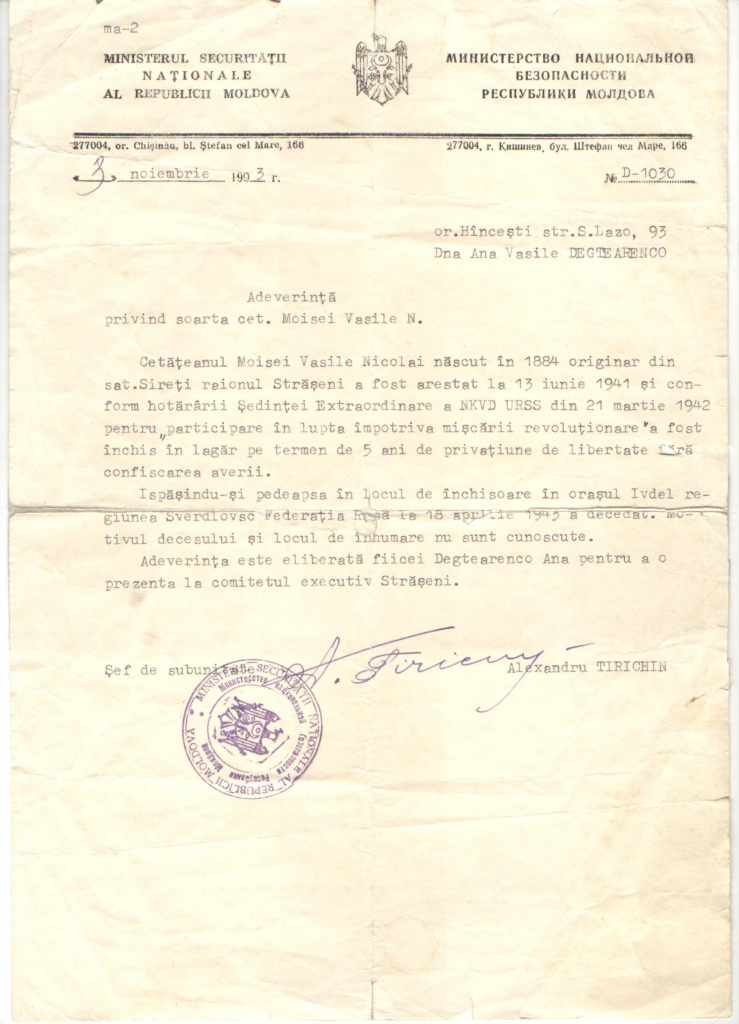
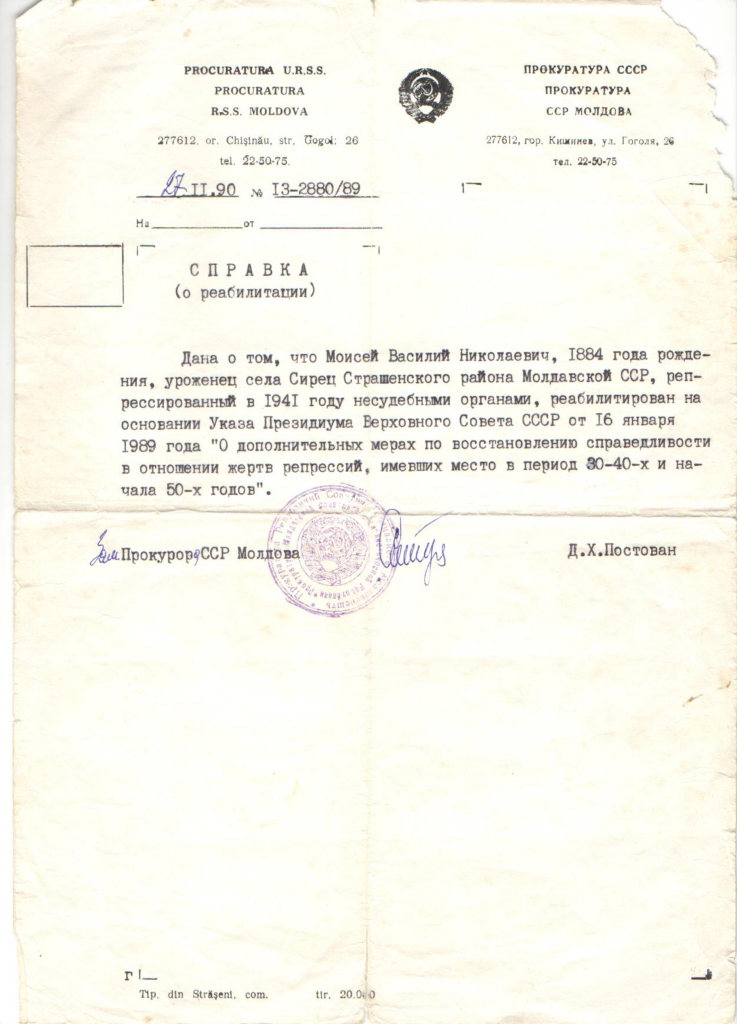
Bunelul, Moisei Vasile, fusese primar în satul lui de baștină, începând cu anul 1918. Către venirea sovieticilor el nu mai deținea această funcție, ci își lucra cu forțele proprii postata de pământ, pe care o avea în posesie. Cu alte cuvinte, era un țăran obișnuit, ca mulți alți consăteni. Da, gospodăria de care dispunea era destul de bună, pentru a stârni cuiva invidia: avea peste 9 ha de pământ, vacă, cal, căruță, o casă de piatră ridicată în inima satului. Dar și familia sa era numeroasă, crescând tocmai cinci fete. Însă, ca rezultat al instaurării regimului sovietic, pe toți i-au „ridicat” în noaptea de 12 spre 13 iunie 1941…
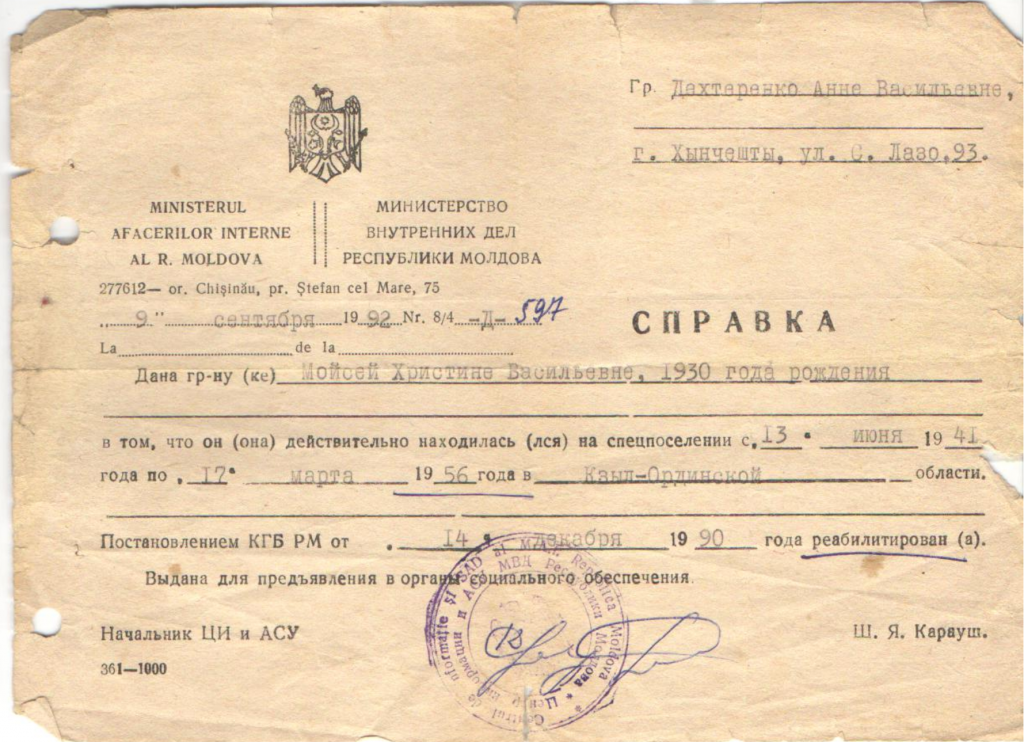
Pe bunic l-au dus în lagărul de muncă silnică din orașul Ivdel, regiunea Sverdlovsk, iar soția (bunica mea, Ana), împreună cu cele cinci copile, s-a pomenit strămutată în Republica Kazahă, regiunea Kzîl-Orda, localitatea Teren-Uzeak. Din puțina informație, pe care o deținem la moment, știm că în anul 1943 Moisei Vasile a decedat, iar cauza decesului și locul înhumării sale așa și nu ne-au fost anunțate nici de către organele de resort din URSS, nici din actuala Federație Rusă. Deși îmi dau destul de bine seama și sunt singură de ce i s-a întâmplat în Siberia „de gheață”. A muncit din greu la tăierea pădurii, fiind sumar îmbrăcat, fără o alimentare adecvată, fără asistență medicală, în condițiile unei clime aspre de taiga. Toate acestea, luate la un loc, i-au deteriorat sănătatea. În același timp, bunica, cu cei cinci copii minori, ducea o luptă aprigă pentru supraviețuire în partea aridă și nu mai puțin friguroasă a Kazahstanului. Acolo au fost ținuți sub un control strict al autorităților locale, fiind lipsiți de orice sursă de existență și de dreptul de a părăsi localitatea. Ca să nu moară de foame, de rând cu alți nenorociți din exilul forțat, strângeau prin coclauri tot felul de semințe sălbatice, spice de plante cerealiere, rădăcini comestibile, ierburi… mai mult noaptea, pe ascuns, căci în cazul că ar fi fost prinși, puteau fi aspru pedepsiți. Într-o bună zi mama și una dintre surorile sale, Veronica, au încercat să fugă în Moldova, dar au fost arestate și trimise la închisoare. De abia către sfârșitul anilor ‘50 li s-ar fi permis să plece din Teren-Uzeak spre altă destinație. După decesul anunțat al bunicului, pentru a putea supraviețui în condițiile intemperiilor și restricțiilor dure, bunica s-a recăsătorit cu un moldovean (tot fost primar, trimis la muncă corecțională în Kazahstan), născând încă o fată, pe care au numit-o Valentina. Dintre toate surorile mamei, numai mătușa Valea mai este în viață, celelalte deja au decedat. Câteodată ne întâlnim și ne amintim despre timpurile, când erau în viață și bunica, și mama. Suntem copleșite de emoții și ne bucură doar un singur lucru: copiilor care s-au născut în perioada deportărilor le-a fost recunoscut statutul de victimă a regimului totalitar comunist. Acum pot miza pe unele înlesniri, deocamdată mulțumindu-se cu 700 de lei adaos la pensia mizeră ce o au.
Îmi pare rău că nu mi-am cunoscut deloc bunicul. Mama se temea să ne povestească ce știe despre soarta părintelui său, dar și despre perioada deportărilor și atrocităților prin care a trecut personal. Bunica ne avertiza mereu să nu spunem nimănui nimic despre familia noastră, deoarece am fost declarați „dușmani ai poporului”. Eu, fiind mică, nu puteam înțelege ce anume se avea în vedere. Abia la vârsta majoratului mi-a devenit clar, că familia mea a avut de suferit injustiții cutremurătoare și mult prea mari lipsuri din cauza regimului inuman stalinist. Frica de repetarea persecuțiilor a fost atât de mare, încât nici astăzi nu cunosc mai nimic din istoria vieții lor, pe care au avut-o înainte de a fi strămutați din Moldova. Simt că mai am încă multe de aflat, dorind foarte mult să văd casa bunicilor, locul de unde au fost duși în Siberia și Kazahstan. Aș vrea să știu ce rude de-ale noastre mai sunt în viață.
Uneori gândesc că bunicul a sfârșit ca un martir în lagărul siberian nu doar din cauza viziunilor sale politice*, dar și din culpa unor invidioși, care l-au denunțat și au depus mărturii false împotriva lui. Cu ce oare s-au pricopsit ticăloșii?..
Astăzi aceste reflecții îmi trezesc sentimente de tristețe că am pierdut oameni dragi, pe care nu i-am știut niciodată. Au plecat de lângă noi și nu a rămas nimic de la ei, de parcă nici n-au existat. Cât nu m-am străduit în căutări, nicăieri nu am putut găsi măcar o simplă fotografie de-a bunicului Vasile, ca să am o amintire despre cel ce a stat la rădăcina neamului meu, dar care a fost dus departe de satul natal și înmormântat pe meleaguri străine…
* Anexa dovezilor grafice (3 documente).
THE FATE OF MY PREDECESSORS
Barbaroș Claudia, professor of history and education for society, IPLT "Ginta Latină", Chișinău
Throughout the ages, our Romanian people have gone through an uninterrupted series of tragedies: invasions, epidemics, wars, occupation, organized famine, mass deportations, repression. Their history seems unlikely, but unfortunately it remains far too true.
For several years I have been asking a question: why was my grandparents’ family deported – a family of midwives from Sireți village, Straseni district?
His grandfather, Moses Vasile, had been mayor of his native village since 1918. By the time the Soviets arrived, he no longer held this position, but worked with his own forces posted by the land, which he had in possession, in other words, was an ordinary peasant, like many other countrymen. Yes, the household he had was good enough to arouse one’s envy: he had over 9 ha of land, a cow, a horse, a cart, a stone house built in the heart of the village. But his family was also large, raising five girls. However, as a result of the establishment of the Soviet regime, they were all raised on the night of June 12-13, 1941 …
My grandfather was taken to the forced labor camp in the town of Ivdel in the Sverdlovsk region, and his wife (my grandmother, Ana), along with her five children, was relocated to the Republic of Kazakhstan, the Kzil-Orda region, the town of Teren- Uses. From the little information we have at the moment, we know that in 1943 Moses Vasile died, and the cause of death and the place of his burial were not announced to us either by the relevant bodies of the USSR or by the current Russian Federation. . Although I realize quite well what happened to him in „ice” Siberia. He worked hard to cut down the forest, being scantily clad, without adequate nutrition, without medical care, in the conditions of a harsh taiga climate. All this, taken together, damaged his health. At the same time, her grandmother, with her five minor children, was fighting hard for survival in the arid and no less cold part of Kazakhstan. There they were kept under the strict control of the local authorities, being deprived of any source of existence and the right to leave the locality. In order not to starve, along with other bastards from the forced exile, they collected all kinds of wild seeds, ears of cereals, edible roots, herbs … more at night, secretly, because in case they were caught, they could be severely punished. One day, my mother and one of her sisters, Veronica, tried to flee to Moldova, but were arrested and sent to prison. It was not until the late 1950s that they were allowed to leave Uzean Land for another destination. After her grandfather’s announced death, in order to survive the harsh weather and restrictions, her grandmother remarried a Moldovan (also a former mayor, sent to correctional work in Kazakhstan), giving birth to another daughter, whom they named Valentina. Of all the mother’s sisters, only Aunt Valea is still alive, the others have already died. Sometimes we meet and remember the times when my grandmother and mother were alive. We are overwhelmed by emotions and we are happy with only one thing: the children who were born during the deportations were recognized as victims of the totalitarian communist regime. Now I can bet on some facilities, for the time being, being satisfied with 700 lei in addition to the miserable pension they have.
I’m sorry I didn’t meet my grandfather at all. My mother was afraid to tell us what she knew about her father’s fate, but also about the period of deportations and atrocities she had personally gone through. Grandma always warned us not to tell anyone about our family, because we were declared „enemies of the people.” When I was little, I couldn’t understand what was going on. It was only at the age of adulthood that it became clear to me that my family had suffered terrible injustices and far too many shortcomings because of the inhuman Stalinist regime. The fear of repeated persecution was so great that even today they know nothing of the history of their lives, which they had before being displaced from Moldova. I feel that I still have a lot to learn, wanting very much to see my grandparents’ house, the place where they were taken to Siberia and Kazakhstan. I would like to know which of our relatives are still alive.
Sometimes I think that my grandfather ended up as a martyr in the Siberian camp not only because of his political views *, but also because of some envious people who denounced him and gave false testimony against him. What did the villains do with it? ..
Today these reflections arouse in me feelings of sadness that I have lost loved ones, whom I never knew. They left us and there was nothing left of them, as if they did not even exist. While I was not searching, I could not find a single photograph of my grandfather Vasile anywhere, to have a memory of the one who was at the root of my nation, but who was taken away from his native village and buried in foreign lands …
* Annex of graphic evidence (3 documents).